
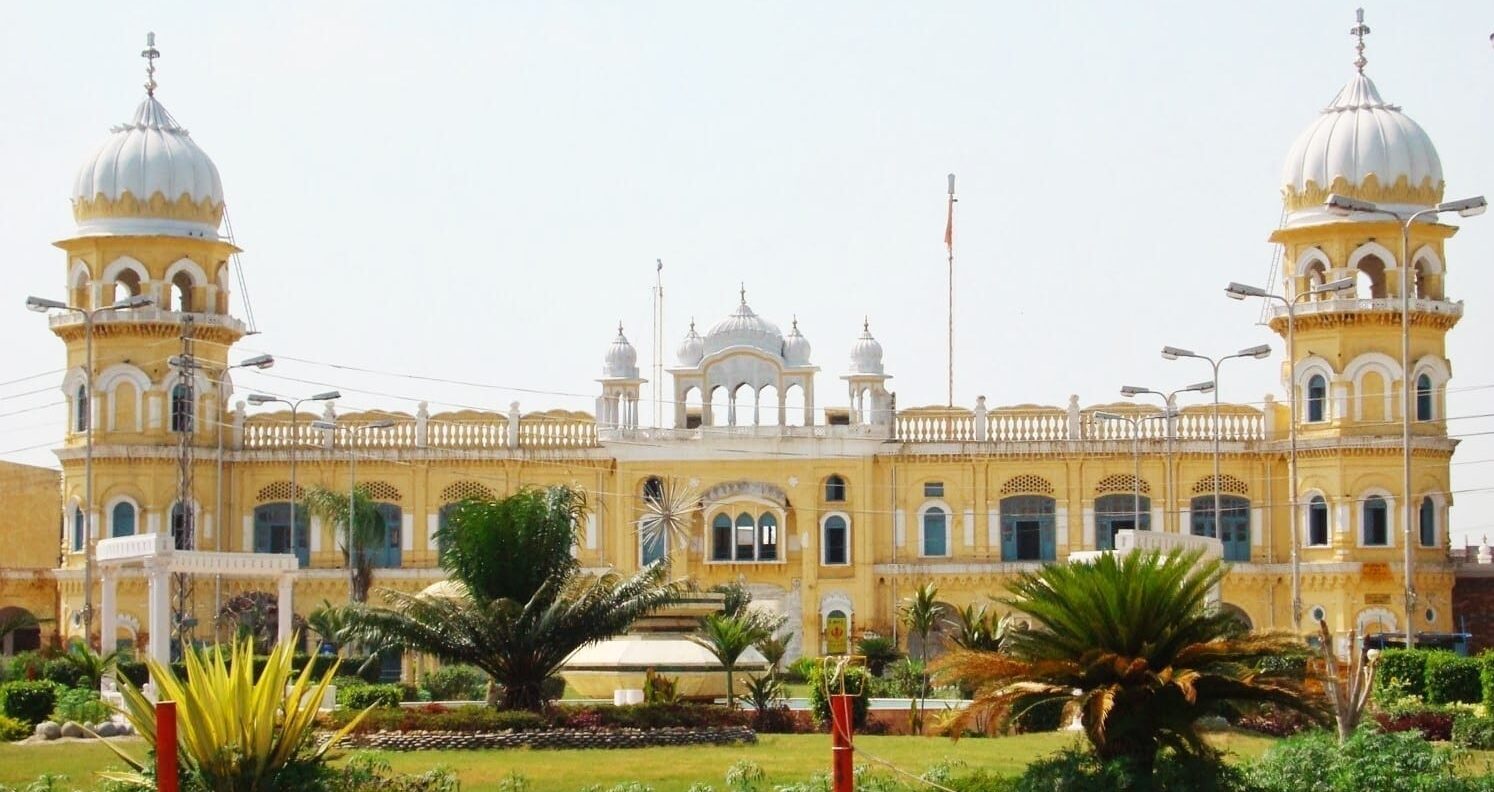
Nankana Sahib is the historic city in Pakistan’s Punjab province associated with the birth of Guru Nanak Dev Ji in 1469. The city is centred on Gurdwara Janam Asthan, but its religious importance extends across several other historic gurdwaras connected with Guru Nanak’s early life and later Sikh history. Nankana Sahib also became a defining place in the Sikh Gurdwara Reform Movement after the violence of 1921. Today, the birthplace remains an important Sikh pilgrimage destination, while the surrounding city functions as the administrative headquarters of Nankana Sahib District.
Nankana Sahib was once Rai-Bhoi-Di-Talwandi
The settlement associated with Guru Nanak was historically known as Rai-Bhoi-Di-Talwandi. The Nankana Sahib District Government records that the township was founded by Rai Bhoi and that his great-grandson Rai Bular Bhatti later renamed it Nankana Sahib after Guru Nanak’s birth.
The older name is significant because Guru Nanak lived in a Punjab that had no modern international boundary separating India and Pakistan. Nankana Sahib therefore belongs to the shared historical geography of the Punjab, while its present location within Pakistan is the result of events many centuries later.
The city is approximately 80 Kms west of Lahore and around 75 kms east of Faisalabad, placing the birthplace within reach of two of Punjab’s major urban centres.
Gurdwara Janam Asthan marks the birthplace
Gurdwara Janam Asthan, also known as Gurdwara Nankana Sahib, is the principal shrine associated with Guru Nanak’s birthplace. The Nankana Sahib District Government identifies it as the site of Guru Nanak’s birth and as a protected heritage monument under the Archaeology Department of the Government of Punjab.
The building visible today represents several periods of construction rather than an untouched fifteenth-century structure. According to the district’s historical record, the gurdwara was originally constructed around 1600 CE, renovated in 1819–20, and received further architectural additions during the 1930s and 1940s.
That distinction helps explain what visitors actually encounter. The sacred importance of the location comes from its association with Guru Nanak’s birth, while the surviving architecture reflects later generations who maintained and developed the shrine.
Nankana Sahib gurdwaras preserve a wider sacred landscape
The significance of Nankana Sahib cannot be understood by looking only at Janam Asthan. The Shiromani Gurdwara Parbandhak Committee lists several historic gurdwaras in the city and surrounding area, including Bal Lilah, Patti Sahib, Mall Ji Sahib, Kiara Sahib, Tambu Sahib, Guru Hargobind Sahib and Nihang Singhan.
These shrines do not all represent the same type of historical material. Some preserve traditional accounts from the Janam Sakhis, others relate to later Sikh figures, and some have limited documentary information. For that reason, the article treats traditional narratives as part of Sikh religious memory rather than presenting every miraculous or biographical detail as independently verified fifteenth-century history.
| Gurdwara | Association |
|---|---|
| Janam Asthan | Guru Nanak’s birthplace |
| Bal Lilah | Childhood |
| Patti Sahib | Education |
| Mall Ji Sahib | Childhood tradition |
| Kiara Sahib | Janam Sakhi |
| Tambu Sahib | “True business” |
| Guru Hargobind Sahib | Later Sikh history |
| Nihang Singhan | Limited evidence |
This variety is what gives Nankana Sahib its unusual character. Instead of commemorating one isolated event, the city preserves a network of places through which different stages of Sikh memory have been attached to the same landscape.
Bal Lilah reveals how a gurdwara could hold land
Gurdwara Bal Lilah lies about 400 yards from Janam Asthan. The SGPC record for Gurdwara Bal Lilah associates the site with Guru Nanak’s childhood and the Nanaksar pond.
One of the most revealing details in the historical record is not a legend but a property figure: Bal Lilah formerly held 120 acres of land together with a cash endowment.
That detail provides a useful window into the institutional history of historic gurdwaras. They could possess agricultural property and financial resources, meaning that management of a shrine could involve questions of land and income as well as religious authority.
The SGPC record states that the gurdwara was associated with Nirmala management before the Saka of 1921, later came under panthic management during the reform movement and was subsequently administered by the Pakistan Waqf Board after Partition. The same record says that the Bal Lilah sarovar is currently dry.
Patti Sahib connects Nankana Sahib with learning
Gurdwara Patti Sahib preserves the traditional association of Guru Nanak with early education. The SGPC account of Patti Sahib connects the site with his learning and with the traditional account of studying Persian under Maulvi Kutab-Ud-Din.
The shrine therefore occupies a different place in the sacred geography of Nankana Sahib. Janam Asthan represents birth, while Patti Sahib represents learning. Together, they form part of the remembered landscape of Guru Nanak’s early years.
The association is particularly interesting because it moves the story beyond the familiar birthplace narrative. Nankana Sahib preserves not only where Guru Nanak is believed to have been born but also places associated with the formation of his early life.
Kiara Sahib preserves a Janam Sakhi landscape
Gurdwara Kiara Sahib is approximately 1.5 kms from Janam Asthan. The SGPC’s Kiara Sahib record connects the site with a Janam Sakhi account concerning Guru Nanak’s youth and cattle grazing.
The importance of the site lies partly in the way a remembered story became attached to a particular piece of land. This is characteristic of pilgrimage landscapes: religious memory can give a specific field, tree, pond or building a significance that extends beyond its physical appearance.
Kiara Sahib consequently helps explain why visiting Nankana Sahib involves more than entering one large gurdwara complex. Several locations around the city carry their own associations.
Tambu Sahib preserves the “true business” tradition
Gurdwara Tambu Sahib is about 1 kilometre from Janam Asthan. The SGPC record for Tambu Sahib connects the site with the traditional account in which Guru Nanak used money intended for a commercial transaction to provide food to hungry religious seekers.
The episode became remembered as the “true business.” Its importance is therefore ethical as much as geographical. The story turns an ordinary commercial transaction into a teaching about service and the use of wealth.
For visitors moving between Nankana Sahib’s gurdwaras, Tambu Sahib provides a different kind of connection with Guru Nanak from Janam Asthan. One commemorates birth; the other preserves a teaching expressed through a remembered event.
Guru Hargobind Sahib adds a later chapter
Nankana Sahib continued to hold Sikh significance after Guru Nanak’s lifetime. The SGPC record for Gurdwara Guru Hargobind Sahib associates the site with a visit by Guru Hargobind Sahib in 1613.
This later association is important because it shows that Nankana Sahib was not frozen in the fifteenth century. Its sacred geography continued to develop as later Sikh history became connected with locations in and around the city.
The result is a layered pilgrimage landscape: Guru Nanak’s birthplace forms the centre, childhood traditions surround it, and later Sikh history adds further depth.
The Saka Nankana Sahib of 1921
Nankana Sahib entered a new phase of its history on 20 February 1921. The Nankana Sahib District Government’s historical account records that violence took place at Janam Asthan during the Sikh Gurdwara Reform Movement and identifies Mahant Narain Das, the Udasi mahant associated with the shrine, in the events.
The killings caused widespread outrage and became a major turning point in the campaign for Sikh control and reform of historic gurdwaras.
The number of victims is reported differently by different sources. Rather than presenting a disputed figure as settled fact, it is more accurate to emphasize the firmly established elements: the violence occurred at Janam Asthan on 20 February 1921, many Sikh protesters were killed, and the event accelerated the movement for reform of gurdwara management.
The Saka therefore changed the meaning of Nankana Sahib in modern Sikh memory. The city was no longer remembered only as Guru Nanak’s birthplace. It also became a major symbol of the struggle surrounding Sikh religious institutions.
Why land matters in the history of the Saka
The 1921 events are commonly discussed through the religious and institutional struggle over gurdwara management, but recent scholarship has examined additional factors.
A 2025 study by Munish Singh, Muhammad Hassan Rai and Mazhar Abbas examines thirty-six dholas associated with Punjabi poet Noori Kamboka and argues that economic interests, personal hostility and other local factors may have contributed to the conflict alongside religious issues. The Journal of Social and Organizational Matters study pays particular attention to the increased value of gurdwara land following canal irrigation.
This does not replace the established history of the Gurdwara Reform Movement. It adds another dimension to it. The 120-acre landholding recorded at Bal Lilah shows why property could matter in the administration and influence of historic gurdwaras.
Partition changed access to the sacred city
The events of 1947 transformed Nankana Sahib again. The Nankana Sahib District Government records that Sikh and Hindu minorities migrated to India after Partition while Muslim refugees from India settled in western Punjab.
The shrines themselves remained in Pakistan. What changed was the population surrounding them and the way many Sikh devotees could reach them.
Before Partition, movement through Punjab did not require crossing an international border. Afterwards, visiting Guru Nanak’s birthplace from India became an international pilgrimage requiring government permissions and travel documentation.
This is one of the defining realities of Nankana Sahib today: the sacred site remained geographically fixed while its relationship with the Sikh community became shaped by an international boundary.
Nankana Sahib became a district in 2005
The modern administrative identity of Nankana Sahib is much younger than its religious history. According to the Nankana Sahib District Government, the area was formerly a tehsil of Sheikhupura District and became a separate district in May 2005.
The distinction matters because the name now describes two overlapping histories. Nankana Sahib is a centuries-old Sikh sacred centre and, at the same time, the headquarters of a modern Pakistani district.
The district is not simply a pilgrimage enclosure. Agriculture, villages, roads, educational institutions, health services and ordinary civic activity exist alongside the historic gurdwaras.
Nankana Sahib in 2026
The Nankana Sahib District Government describes the district as an area of historical and religious importance with agriculture and farming among its major activities. The district covers approx. 2,960 square kilometres and includes three tehsils.
This contemporary context is easy to overlook when reading about Guru Nanak’s birthplace. Nankana Sahib is not an archaeological city preserved outside modern life. The gurdwaras remain part of a functioning Pakistani city and district.
For a visitor, that means the pilgrimage experience combines historic religious sites with the practical realities of present-day travel, local administration and international border arrangements.
Visiting Nankana Sahib
Nankana Sahib is an international pilgrimage destination, so the practical arrangements are different from visiting a Sikh shrine within India. Gurdwara Janam Asthan is the principal destination, while other historic gurdwaras have their own current arrangements.
The Nankana Sahib District Government’s information on Gurdwara Nankana Sahib identifies Janam Asthan as a protected heritage site and an important pilgrimage destination.
A reliable official 2026 daily opening and closing timetable for Janam Asthan could not be verified. So sharing an exact schedule without authoritative confirmation would therefore be misleading. Pilgrims should confirm arrangements for their actual travel date, particularly when travelling with an organized jatha.
Nankana Sahib from India
For Indian Sikh pilgrims, the journey is governed by specific religious-shrine arrangements between India and Pakistan rather than ordinary tourist travel alone.
The Ministry of External Affairs, Government of India identifies the gurdwaras of Nankana Sahib and Gurdwara Janam Asthan among the religious shrines covered by the 1974 Protocol on Visits to Religious Shrines.
The practical arrangements for a particular pilgrimage can change. Pilgrims should therefore check the current instructions issued for the relevant yatra instead of assuming that an earlier pilgrimage operated under identical conditions.
How to reach Nankana Sahib
Nankana Sahib is approximately 80 kilometres west of Lahore and about 75 kilometres east of Faisalabad. Lahore is the most useful major-city reference point when planning the onward journey.
For Indian pilgrims travelling as part of an organized jatha, the actual route can depend on the border crossing, pilgrimage schedule, transport arrangements and permissions applicable at that time.
Nankana Sahib should also not be confused with Kartarpur. The two are separate Sikh pilgrimage destinations with different access arrangements.
Nankana Sahib visa requirements
Pakistan provides a dedicated Pilgrim Tourism (Sikh Yatrees Visa) category. The Pakistan Ministry of Foreign Affairs lists documentation that can include sponsorship or invitation material, accommodation information and supporting financial or personal records.
Commonly relevant documents include:
- Valid passport.
- Sponsorship or invitation letter from an accepted Pakistani sponsor.
- Confirmed accommodation where required.
- Recent bank statement.
- Proof of residence.
- Employment verification where applicable.
- Student verification where applicable.
- Any additional documents requested during the application process.
The exact requirements can depend on nationality and the location from which the application is submitted. Current official instructions should therefore be checked immediately before applying.
Pakistan reported issuing 2,942 visas to Sikh pilgrims in November 2025 for travel through the Wagah border during the Guru Nanak birth-anniversary pilgrimage. This demonstrates recent organized pilgrimage activity but should not be interpreted as a guaranteed number or arrangement for 2026. Pakistan Ministry of Foreign Affairs provides the relevant official information.
Nankana Sahib visiting information
| Detail | Current guidance |
|---|---|
| Main shrine | Gurdwara Janam Asthan |
| Country | Pakistan |
| Province | Punjab |
| Major city nearby | Lahore |
| Distance from Lahore | About 80 km |
| Daily hours | Verify before travel |
| Foreign pilgrims | Visa required |
| Indian pilgrims | Bilateral arrangements |
| Kartarpur Corridor | Separate destination |
What pilgrims should carry
International visitors need to prepare for both cross-border travel and religious observance. Practical items include:
- Passport and approved visa.
- Copies of important documents.
- Sponsorship or pilgrimage paperwork.
- Accommodation details where applicable.
- Necessary personal medicines.
- Modest clothing.
- Head covering for gurdwara visits.
- Emergency contact information.
- Travel insurance documents, where applicable.
Important points before travelling
- Check the current visa rules. Do not rely on an old pilgrimage checklist.
- Confirm the jatha itinerary. Organized pilgrimages can have designated routes and schedules.
- Keep original documents accessible. International travel requires valid documentation.
- Verify shrine arrangements. Smaller gurdwaras may not follow the same arrangements as Janam Asthan.
- Follow local security instructions. Conditions can be different during major gatherings.
- Do not use Kartarpur information for Nankana Sahib. They are separate pilgrimage destinations.
- Confirm visiting hours before departure. An unofficial timetable should not be treated as authoritative.
The 1974 protocol and Nankana Sahib pilgrimage
The movement of pilgrims between India and Pakistan has a diplomatic framework dating from the 1974 Protocol on Visits to Religious Shrines. The Government of India’s religious-shrine protocol establishes arrangements for visits to designated religious sites. The GOI’s published list of shrines specifically includes the gurdwaras of Nankana Sahib and Gurdwara Janam Asthan. This framework is separate from the Kartarpur Corridor arrangement. A traveller should therefore not assume that rules applying to Kartarpur automatically apply to Nankana Sahib.
FAQ’s
Where is Nankana Sahib?
Nankana Sahib is in Punjab province, Pakistan, approximately 80 kilometres west of Lahore and about 75 kilometres east of Faisalabad. It is the headquarters of Nankana Sahib District.
Why is Nankana Sahib important to Sikhs?
Nankana Sahib is associated with the birth of Guru Nanak Dev Ji in 1469. Gurdwara Janam Asthan commemorates the birthplace, while other gurdwaras preserve traditions and later historical associations connected with Sikh history.
What was Nankana Sahib called before?
The settlement was known as Rai-Bhoi-Di-Talwandi. According to the official district history, Rai Bular Bhatti later renamed it Nankana Sahib after Guru Nanak’s birth.
Which gurdwara marks Guru Nanak’s birthplace?
Gurdwara Janam Asthan, also known as Gurdwara Nankana Sahib, is the principal shrine associated with Guru Nanak’s birthplace.
What happened at Nankana Sahib in 1921?
On 20 February 1921, violence at Janam Asthan resulted in the deaths of Sikh protesters during the Gurdwara Reform Movement. The Saka Nankana Sahib became a major event in the campaign for reform of Sikh gurdwara management.
Can Indian Sikh pilgrims visit Nankana Sahib?
Indian Sikh pilgrims can visit under the applicable religious-shrine and visa arrangements between India and Pakistan. Nankana Sahib and Gurdwara Janam Asthan are included among the shrines covered by the relevant bilateral framework.
What are the Nankana Sahib visa requirements?
Pakistan has a Pilgrim Tourism (Sikh Yatrees Visa) category. Requirements can include a valid passport, sponsorship or invitation documentation, accommodation information and supporting personal or financial documents. Current requirements should be checked through Pakistan’s official visa guidance before applying.
Is Nankana Sahib part of the Kartarpur Corridor?
No. Nankana Sahib and Kartarpur Sahib are separate pilgrimage destinations. The Kartarpur Corridor is associated with Gurdwara Darbar Sahib Kartarpur.
Is there a fixed daily visiting time for Gurdwara Janam Asthan?
A reliable official 2026 daily opening and closing timetable could not be verified. Visitors should confirm the current arrangements before travelling.
When did Nankana Sahib become a district?
Nankana Sahib became a separate district in May 2005, after previously being a tehsil of Sheikhupura District.
What is unusual about Gurdwara Nihang Singhan?
The SGPC lists Gurdwara Nihang Singhan among the Nankana Sahib shrines, but its current record indicates that historical evidence connecting the shrine with a particular event is not available. It is therefore an example of why the individual traditions associated with Nankana’s gurdwaras should be examined separately.
References
- Government of Punjab, Pakistan. Our History: Nankana Sahib: Nankana Sahib District Government
- Government of Punjab, Pakistan. Important Places: Nankana Sahib District Government
- Government of Punjab, Pakistan. District Profile: Nankana Sahib District Government
- Shiromani Gurdwara Parbandhak Committee. Gurdwaras in Pakistan: SGPC
- Shiromani Gurdwara Parbandhak Committee. Gurdwara Bal Lilah Nankana Sahib: SGPC
- Shiromani Gurdwara Parbandhak Committee. Gurdwara Patti Sahib: SGPC
- Shiromani Gurdwara Parbandhak Committee. Gurdwara Kiara Sahib Nankana Sahib: SGPC
- Shiromani Gurdwara Parbandhak Committee. Gurdwara Tambu Sahib Nankana Sahib: SGPC
- Ministry of Foreign Affairs, Pakistan. Visa Services: Pakistan Ministry of Foreign Affairs
- Ministry of External Affairs, Government of India. Protocol on Visits to Religious Shrines: Government of India
- Ministry of External Affairs, Government of India. Religious shrines identified under the 1974 Protocol: Government of India
- Singh, Munish; Rai, Muhammad Hassan; Abbas, Mazhar. Revisiting Saka Nankana (1921): Potential Factors and Probable Effects: Journal of Social and Organizational Matters