

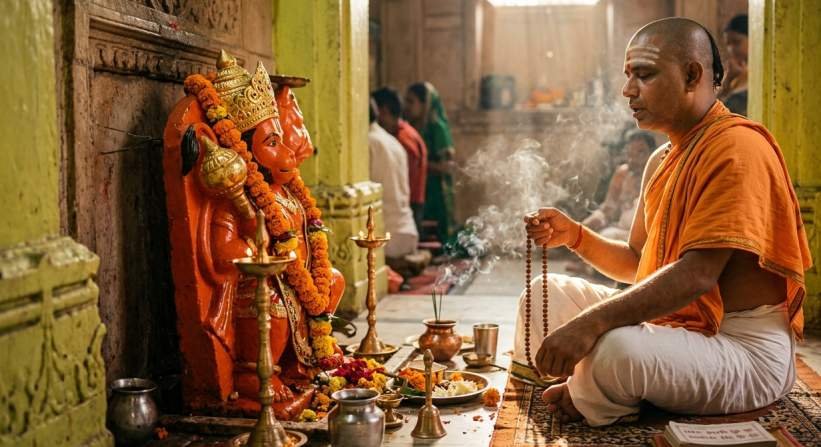
Morning in an Indian household does not begin with the sunrise. It begins with sound. Long before the first whistle of the pressure cooker or the scent of boiling chai, a familiar tune plays on a phone or a small kitchen radio. We sing along while lighting the dhoop, knowing the verses by pure muscle memory.
But memory often breeds habit, and habit makes us deaf to the actual words. When we listen to a beautifully penned ghazal (like when a voice sings a line such as ‘Yeh kaun ro raha hai is tarah’) we stop what we are doing. We let the weight of the poetry sit in the room. We respect the emotion. Yet we rarely offer that same stillness to our morning chants. If we strip away the religious habit, we realize these daily prayers are profound, ancient poetry designed to anchor the human mind and grant us a quiet sukoon before the day demands our energy.
The Hidden Psychology of the Hanuman Chalisa
Tulsidas did not just write the Hanuman Chalisa as a ritual offering. He wrote a psychological survival guide for navigating human vulnerability.
Look at this verse: “Sankat kate mite sab peera, jo sumirai Hanumat Balbeera.”
We often sing this as a passive request for a sudden miracle to make our problems disappear. But looked at closely, it is a masterclass in internal resilience:
- Acknowledging the Crisis (Sankat): The poetry does not pretend life is easy. It validates human suffering and panic rather than dismissing it.
- The Power of Remembrance (Sumirai): This is the operative word. It is a call to active mindfulness. It implies that relief comes from shifting where we place our attention.
- The Internal Hero: The verse reminds us that when external circumstances are terrifying, remembering our own capacity for immense strength and devotion is what actually cuts through the pain. The courage is not just out there. It is already sitting inside us, waiting to be summoned.
The Architecture of ‘Sukoon’
There is a physical reason why reciting these verses changes how we feel. The peace we experience is not just faith; it is biology reacting to sound. You do not need a modern meditation app to calm a racing mind when you understand the mechanics of a bhajan.
- The Linguistic Meter: The specific syllable arrangements in Awadhi and Sanskrit poetry naturally force the speaker to regulate and slow down their breathing.
- Nervous System Reset: Matching your breath to this ancient, steady rhythm signals your parasympathetic nervous system to stand down, and your heart rate drops naturally.
- The Anchor Effect: Repeating familiar, uplifting words stops the brain from spiraling into the day’s anxieties. It is a highly effective grounding technique wrapped in melody.
The Gayatri Mantra: An Ancient Plea for Mental Clarity
While the Hanuman Chalisa offers a framework for courage, the Gayatri Mantra offers something equally critical for the modern mind: absolute clarity. We often recite its syllables at a rapid pace and completely miss the profound gravity of its final line.
“Dhiyo Yo Nah Prachodayat” (May that divine light awaken and illuminate our intellect.)
When you break down this ancient Sanskrit verse, it becomes clear that it is not asking for wealth, health, or sudden miracles. It is a highly specific request for a clear mind. In today’s world of endless digital noise, brain fog, and decision fatigue, this is the ultimate poetic plea. It is a daily, deliberate reminder to seek out the truth, filter out the unnecessary chaos, and make decisions with an illuminated, unclouded intellect.
The Voices of the Mystics: Kabir and the Poetry of Surrender
If the Sanskrit mantras of the morning are about structure and clarity, the vernacular bhajans of the Bhakti movement are about raw, unfiltered emotion. When we listen to the poetry of saints like Kabir Das or Meera Bai, we are stepping away from formal ritual and entering a deeply personal conversation with the divine.
Think of one of Kabir’s most famous dohas, often sung as a soulful bhajan:
“Moko kahan dhundhe re bande, main to tere paas mein.” (Where do you search for me, O seeker? I am right beside you.)
When this plays softly in the background, it completely dismantles the idea that spirituality is a chore or a distant destination. The poetry is a gentle, almost playful reminder that we spend so much of our lives running outwards to seek validation, peace, or success in the external world. Meanwhile, the ultimate source of comfort is already sitting quietly within our own hearts. It shifts the entire mood of a stressful day from seeking and striving to simply being.
The ‘Sandhya’ Aarti: The Psychological Shift of Evening Prayers
While morning prayers are designed to gather energy for the day, the evening chants serve the exact opposite psychological purpose. They are the poetry of letting go.
Take the incredibly powerful Shiva mantra often sung during the evening aarti: “Karpur Gauram Karunavtaaram, Sansara Saaram Bhujagendra Haaram.”
- Karpur Gauram (White as Camphor): Camphor is unique because when it burns, it leaves absolutely no ash or residue behind.
- The Deeper Meaning: Singing this at the end of the day is a profound metaphor for releasing our daily burdens. Just as the camphor burns away completely, the poetry asks us to let the stresses, mistakes, and anxieties of the day dissolve entirely. It leaves no residue of worry in our minds as we prepare for rest. It is the perfect psychological boundary between the heavy demands of the workday and the sanctuary of family time.
Designing a Day of ‘Sukoon’
To fully experience the emotional depth of these traditions, we can look at our daily chants not as a monotonous list of rituals, but as a carefully curated emotional soundtrack for different phases of the day.

Passing Down ‘Sanskars’ to the Next Generation
This perspective changes everything about how we raise the next generation. If you sit down with your daughter and simply tell her to memorize a prayer for the sake of tradition, it can easily become just another household chore. But if you share the human story behind the lyrics, you are doing something far more vital. You are teaching her how to navigate life.
You are giving your children a cultural toolkit for their own mental peace.
The beauty of our heritage is that these profound insights are not locked away in dusty libraries or restricted to scholars. They are freely available, woven into the very melodies we hear while making our morning tea.
Tomorrow morning, when the familiar tune starts playing, do not let it become just another sound in the house. Catch a single phrase. Roll the words around in your mind. Let the poetry do exactly what it was written to do, and allow it to bring a quiet, deliberate moment of stillness to your day.