

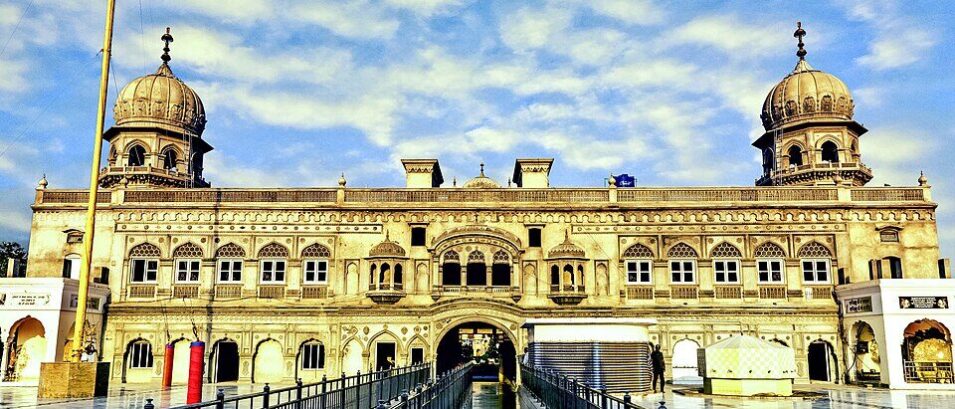
Gurdwara Nankana Sahib, Pakistan’s Punjab
Nankana Sahib is the historic city in Pakistan’s Punjab province associated with the birth of Guru Nanak Dev Ji in 1469. The city is centred on Gurdwara Janam Asthan, but its religious importance extends across several other historic gurdwaras connected with Guru Nanak’s early life and later Sikh history. Nankana Sahib also became a defining place in the Sikh Gurdwara Reform Movement after the violence of 1921. Today, the birthplace remains an important Sikh pilgrimage destination, while the surrounding city functions as the administrative headquarters of Nankana Sahib District.
The settlement associated with Guru Nanak was historically known as Rai-Bhoi-Di-Talwandi.
The older name is significant because Guru Nanak lived in a Punjab that had no modern international boundary separating India and Pakistan. Nankana Sahib therefore belongs to the shared historical geography of the Punjab, while its present location within Pakistan is the result of events many centuries later.The city is approximately 80 Kms west of Lahore and around 75 kms east of Faisalabad, placing the birthplace within reach of two of Punjab’s major urban centres.

The Saka Nankana Sahib of 1921
Nankana Sahib played a significant role in 20 February 1921 and was a key event in modern Sikh history. Violent clashes broke out at Gurdwara Janam Asthan where Udasi maahat Narain Das and his followers were attacked by a large group of Sikh reformists.
Significant effects of Nankana Sahib Saka
Triggering Reform: The incident caused an indignation among Sikhs which led to a wider movement seeking independence of the historic gurdwaras from the corrupt hereditary management and democratize it under the control of Sikh Gurudwara Management Committee (SGMC).
Changing Collective Memory: The incident led to the shifting of Nankana Sahib from a place of reverence as a non violent birthplace of San Guru Nanak Ji to a place that symbolizes martyrdom, sacrifice, and religious authority.
One fact is certain: different accounts give different figures of the number of victims, however, there is no dispute concerning the fact that the armed Sikh activists killed unarmed Sikh protesters at the site on 20 February 1921.
Partition changed access to the sacred city
The events of 1947 fundamentally altered Nankana Sahib’s place in the Sikh world. Following Partition, local Sikh and Hindu populations migrated to India, replaced by Muslim refugees moving west, according to Nankana Sahib District Government records.
While the sacred shrines remained physically unchanged, the human landscape around them was rewritten—and access to them was redefined overnight:
- Border Crossings: Domestic travel across Punjab became an international journey, turning a routine pilgrimage into a complex diplomatic process requiring state permissions and official travel documentation.
- Geographic Isolation: Guru Nanak’s birthplace stayed fixed in space, but a new international boundary suddenly separated the site from the vast majority of the global Sikh community.
Visiting Nankana Sahib
Nankana Sahib is an international pilgrimage destination, so the practical arrangements are different from visiting a Sikh shrine within India. Gurdwara Janam Asthan is the principal destination, while other historic gurdwaras have their own current arrangements.
For Indian Sikh pilgrims, the journey is governed by specific religious-shrine arrangements between India and Pakistan rather than ordinary tourist travel alone.
How to reach Nankana Sahib
Nankana Sahib is approximately 80 kilometres west of Lahore and about 75 kilometres east of Faisalabad. Lahore is the most useful major-city reference point when planning the onward journey.

 21°C
21°C
Nankana Sahib visa requirements
Pakistan provides a dedicated Pilgrim Tourism (Sikh Yatrees Visa) category. The Pakistan Ministry of Foreign Affairs lists documentation that can include sponsorship or invitation material, accommodation information and supporting financial or personal records.
Commonly relevant documents include:
- Valid passport.
- Sponsorship or invitation letter from an accepted Pakistani sponsor.
- Confirmed accommodation where required.
- Recent bank statement.
- Proof of residence.
- Employment verification where applicable.
- Student verification where applicable.
- Any additional documents requested during the application process.
The exact requirements can depend on nationality and the location from which the application is submitted. Current official instructions should therefore be checked immediately before applying.