
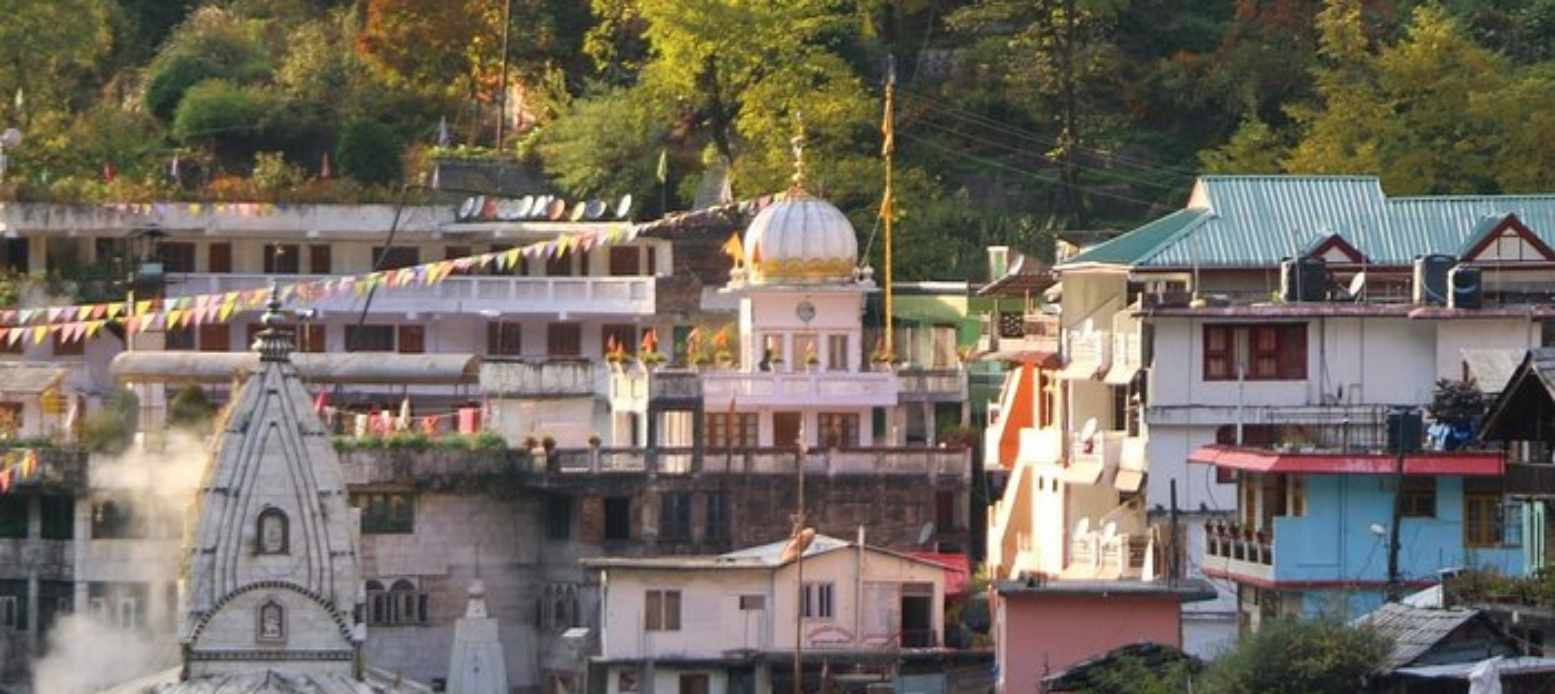
Gurdwara Manikaran Sahib, Himachal Pradesh, stands in the Parvati Valley of Kullu district, where the Parvati River cuts through a steep Himalayan landscape and naturally heated water rises from beneath the valley floor. Manikaran is about 1,829 metres above sea level and around 40 kilometres from Kullu. The settlement is important to Sikh pilgrims because of its traditional connection with Guru Nanak Dev, while nearby Hindu temples have made it a shared pilgrimage destination as well.
What makes Manikaran Sahib especially memorable is the way its religious history is tied to something that visitors can still see and experience today. The hot springs are not simply an attraction beside the Gurdwara. They are closely associated with the traditional account of Guru Nanak’s visit and the preparation of food for langar.
The Guru Nanak tradition preserved at Manikaran
The Sikh tradition of Manikaran Sahib is connected with Guru Nanak Dev and Bhai Mardana, his longtime companion. Mardana travelled extensively with Guru Nanak and accompanied him during his journeys, playing the rabab while the Guru sang hymns.
The Manikaran account centres on a practical problem during their stay. Food needed to be prepared, but there was no ordinary fire available. A hot spring is traditionally said to have appeared after a stone was moved, providing enough heat to cook the food.
The story has survived because it connects the ordinary act of preparing and sharing food with the unusual natural conditions of Manikaran. That connection remains particularly meaningful at a Gurdwara where langar continues to be an important part of the visitor experience.
The account should be understood as part of Sikh tradition associated with the site rather than presented as a modern scientific description of how the springs formed.
The hot springs are part of Manikaran’s identity
The hot springs are the feature that immediately separates Manikaran from most other Sikh pilgrimage destinations. The Kullu district administration records that the principal spring has water above boiling point and describes the traditional practice of cooking rice by placing it in a muslin bag or cloth and lowering it into the hot water.
This is not simply an interesting detail for tourists. The springs have a direct connection with the traditional story of Guru Nanak’s visit and with the preparation of food associated with langar.
The heat also demands caution. Visitors should not assume that naturally occurring spring water is safe to touch or enter. Designated areas and local instructions should always be followed.
What the landscape tells you about Manikaran
Manikaran is a compact settlement, but its surroundings are remarkably dramatic. The Parvati River runs through the valley while mountains rise sharply on both sides. The result is a place where the sound of fast-moving water, the movement of pilgrims and the activity around the springs are all part of the same setting.
The natural environment also affects everyday travel. A journey that looks short on a map can take longer than expected because the road follows difficult Himalayan terrain.
The wider region has ecological importance as well. Information from Himachal Tourism places the Kanwar Wildlife Sanctuary within the broader Parvati Valley landscape, with forests and habitats extending across a substantial range of elevations.
A shared Sikh and Hindu pilgrimage centre
Manikaran is unusual because the Gurdwara exists within a wider religious landscape rather than as an isolated Sikh complex. The Kullu district administration identifies Raghunathji and other religious sites alongside the Gurdwara and records local traditions connecting the area with Lord Shiva and Parvati.
This shared character is visible when walking through the settlement. Religious buildings, hot springs, shops and mountain roads occupy the same narrow valley, creating an atmosphere quite different from major urban pilgrimage centres.
For readers exploring famous Gurdwaras in India, Manikaran Sahib offers a particularly distinctive example because its Sikh history is closely intertwined with the geography and religious traditions of the surrounding valley.
Langar has an unusual connection here
The tradition of langar becomes especially tangible at Manikaran because the hot springs have traditionally been used for cooking. Instead of being merely a story about the past, the relationship between naturally heated water and food preparation has remained part of the identity of the Gurdwara.
That gives the place a useful insight into the practical side of Sikh hospitality. Langar is built around sharing food with others, and at Manikaran the natural environment has become part of the way that tradition is remembered.
The hot spring therefore has significance beyond its temperature. It links the physical landscape with a central practice of Sikh community life.
How to reach Manikaran Sahib
Manikaran is a road-access pilgrimage destination, so visitors do not need to undertake a long trek to reach the Gurdwara.
| Starting point | Travel detail |
|---|---|
| Kullu | About 40 km |
| Bhuntar | Airport access |
| Kullu-Manali Airport | About 36 km |
| Local travel | Bus or taxi |
The nearest airport is Kullu-Manali Airport at Bhuntar, about 36 kilometres from Manikaran. The Kullu district administration also states that Manikaran is connected by road with major destinations in Himachal Pradesh and neighbouring states, with bus and taxi services available.
There is an important 2026 travel detail for anyone planning a current visit. The District Magistrate, Kullu, has imposed traffic restrictions on the Bhuntar-Manikaran Road during the 2026 tourist season because of increased tourist inflow and the narrow road conditions. The order runs from April 14 through August 31, 2026.
This means visitors should check the latest local traffic arrangements before setting out rather than relying on an old travel schedule.
When to visit Manikaran Sahib
Manikaran does not have the same short operating season as high-altitude shrines that become completely inaccessible during winter. Its lower elevation and road connection make visits possible through much of the year.
The more important question is what kind of conditions you prefer.
| Season | Main feature |
|---|---|
| Spring | Mild weather |
| Summer | Busy travel period |
| Monsoon | Heavy rain risk |
| Autumn | Cooler conditions |
| Winter | Cold and possible snow |
Monsoon travel requires particular attention because rainfall can affect mountain roads and river conditions. Winter can be appealing for visitors who prefer a quieter atmosphere, but temperatures are considerably lower.
For a pilgrimage-focused visit, checking current road conditions is more useful than choosing a date solely on the basis of a general travel season.
Places worth seeing around Manikaran
The Gurdwara is naturally the main focus, but the settlement has several other places and features that help explain its importance.
- Gurdwara Manikaran Sahib
- Natural hot springs
- Raghunathji Temple
- Naina Bhagwati Temple
- Parvati River
- Manikaran village
- Surrounding Parvati Valley
The Kullu district administration specifically highlights the Gurdwara, hot springs and religious sites among Manikaran’s principal attractions.
The attractions are close enough that visitors can experience the character of the settlement without planning a separate sightseeing circuit.
What visitors should know before entering the springs
The hot water deserves more caution than its peaceful appearance might suggest. The district administration records temperatures above boiling point at the principal spring, making direct contact with untreated spring water potentially dangerous.
The Parvati River also requires care. Mountain rivers can change quickly, and strong currents make casual entry unsafe. Visitors should stay within appropriate areas and avoid approaching unstable riverbanks simply for photographs.
Inside the Gurdwara, normal religious etiquette applies. Modest clothing, cleanliness and respect for worshippers and the langar arrangements are important.
Why Manikaran Sahib remains important
Manikaran Sahib has a quality that is difficult to reproduce elsewhere. Its connection with Guru Nanak is not represented only by a historical building or a commemorative object. The natural hot springs that form part of the traditional account remain active in the same valley.
That continuity gives the site much of its character. The story of Guru Nanak and Bhai Mardana, the tradition of cooking food, the practice of langar and the geothermal landscape all meet within one small Himalayan settlement.
For pilgrims, that makes Manikaran Sahib more than a stop in the Parvati Valley. It is a place where religious memory and the physical landscape remain closely connected.
Planning a visit to Manikaran Sahib
A visit is relatively straightforward compared with remote Himalayan pilgrimage sites, but the mountain setting should still shape your plans. Allow additional time for road travel, particularly during periods of heavy rain or increased tourist traffic, and check current local restrictions before travelling.
The most rewarding visits are not necessarily the quickest ones. Taking time to understand the Guru Nanak tradition, observe the langar arrangements and experience the hot springs within their religious setting gives Manikaran a much deeper meaning than treating it simply as another scenic destination in Himachal Pradesh.
FAQ’s
Where is Gurdwara Manikaran Sahib located?
Gurdwara Manikaran Sahib is located in Manikaran, Kullu district, Himachal Pradesh, in the Parvati Valley.
Which Sikh Guru is associated with Manikaran Sahib?
Manikaran Sahib is traditionally associated with Guru Nanak Dev and his companion Bhai Mardana.
Why are Manikaran’s hot springs famous?
The naturally heated springs are closely connected with the Sikh tradition surrounding Guru Nanak’s visit and have traditionally been used for cooking food associated with langar.
Can Manikaran Sahib be visited throughout the year?
Manikaran is accessible during much of the year, although monsoon rain, winter weather and mountain-road conditions can affect travel.
How far is Manikaran from Kullu?
Manikaran is approximately 40 kilometres from Kullu, according to the Kullu district administration.
References
- Kullu District Administration: https://hpkullu.nic.in
- Himachal Tourism: https://himachaltourism.gov.in
- The Sikh Encyclopedia: https://www.thesikhencyclopedia.com